


Should Regenerative and Organic be Joined at the Hip?
Jason Haas (Tablas Creek) responds to an industry leader’s assertion that they shouldn’t
février 18, 2026
If you want to play viticultural bingo, ‘regenerative’ is top of the list right now, up there with other dinner-party conversation starters such as soft pruning, dry farming and soil compression.
The R-word is everywhere, but it’s poorly understood. Deploy the phrase ‘regenerative organic’ and it gets downright divisive. Wine writer and viticulture expert Dr. Jamie Goode recently criticised the idea that organic viticulture must be a precursor to regenerative practices. Some practitioners take a different view.Subscribe
Here’s some background, taken from my previous deep dive:
- The phrase ‘regenerative agriculture’ was popularised by Robert Rodale of the Rodale Institute in the 1980s.
- It refers to the practice of restoring soil health and vigour but also tackles the long-term sustainability of ecosystems, communities and social welfare.
- The Rodale Institute created the world’s first regenerative agriculture certification programme in 2020, and founded the Regenerative Organic Alliance (ROC) to regulate and promote the scheme.
- The ROC and the RI maintain that regenerative agriculture is ethically and practically impossible in the context of conventional synthetics and fossil-fuel driven agriculture
- A proliferation of newer certification schemes are more permissive.
- The term regenerative is not legally protected or defined, allowing major agribusinesses such as Bayer and Cargill to dream up their own regenerative programmes which promote the use of – surprise, surprise – their own synthetic products.
A small fancy club?
Dr. Goode recently spoke at a regenerative viticulture forum hosted by Domaine Lafage, a major winery farming 300 hectares in Roussillon. His robust stance on regenerative and organic was summarised in an article published in The Drinks Business. Andrew Neather quotes Goode as saying:
“If we tie regenerative viticulture to organics, it’s finished,” he said. “It will be a small, fancy club for people to feel good about themselves. It’s bullshit. This patronising ROC approach is nonsense.”1
Goode’s position is slightly more nuanced than this snippet suggests. Check out the official video from the conference and make up your own mind. Most of Andrew Neather’s quote is taken from a short segment around eight minutes in.
Domaine Lafage and Goode seem to be aligned. The domaine reportedly struggled to convert some plots to organic viticulture and has now opted for a hybrid approach. Jean-Marc Lafage said “we can’t be organic everywhere … but we feel comfortable working in regenerative.”
Lafage recently gained regenerative certification for 80ha via A Greener World, which allows the use of synthetics with justification. The domaine also has a separate 20ha certified by the Regenerative Viticulture Association2 – a scheme created in 2023 which specifically forbids the use of synthetics. It looks like they cherry-picked different schemes to suit different parts of their estate. I have not spoken with them directly about this.
The gold standard
“If you are trying to rebuild your soils to use them to foster macrobiology and biodiversity,
any application of synthetic chemicals is going to be counter to that goal.” – Jason Haas
I contacted several growers who hold Regenerative Organic Certification (ROC) for their reaction. Most declined to make a public statement, with one exception. Jason Haas has been responsible for steering his family’s Tablas Creek estate first towards biodynamics and then to becoming the world’s first Regenerative Organic Certified winery in 2020. He certainly has skin in the game.
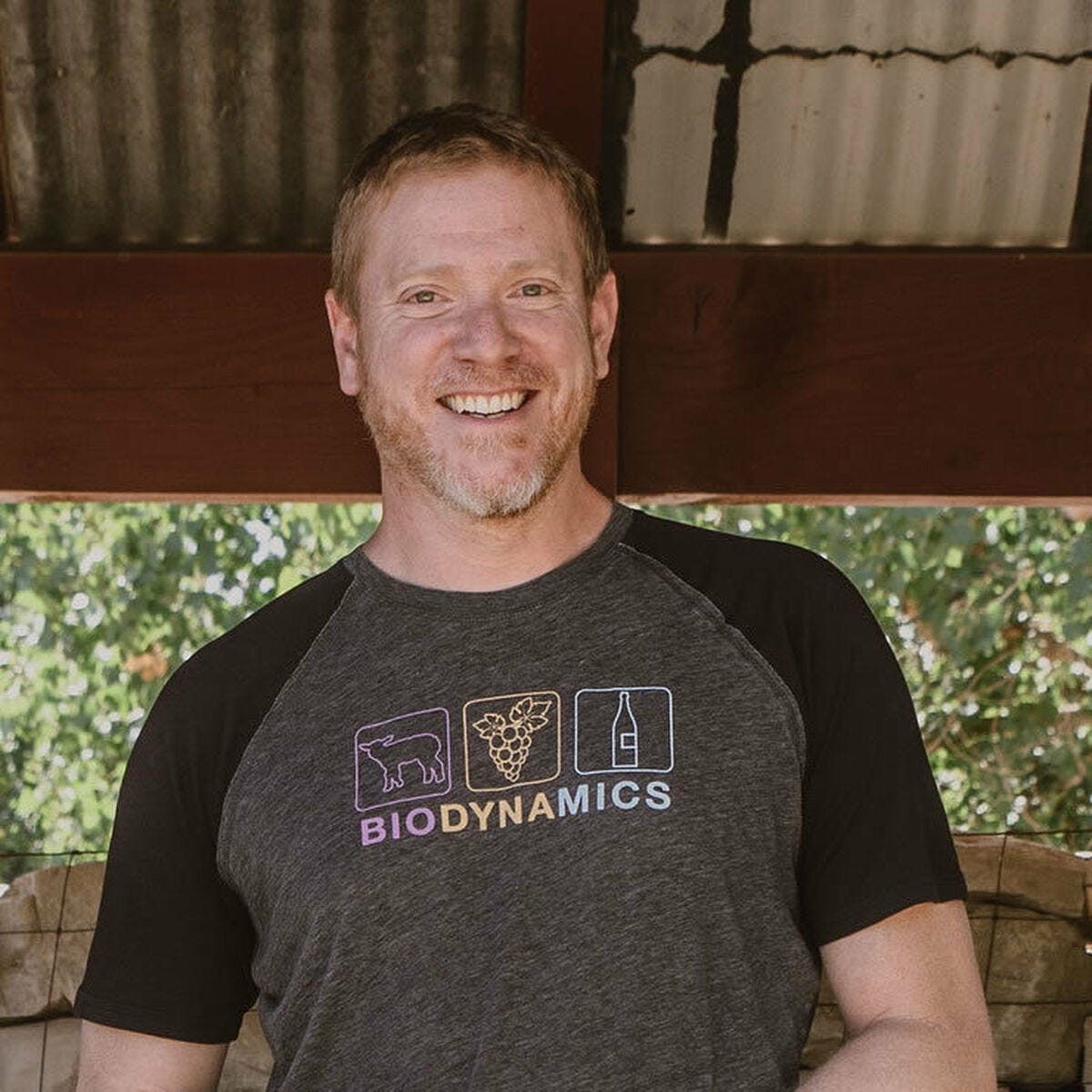
Tablas Creek was created as a joint venture between Château de Beaucastel and the Haas family in 1989, in Paso Robles, California. They farmed according to organic standards from the start, and then adopted biodynamic practices starting in the 2010s. As Jason put it, organic is “just a list of things you can’t do, whereas biodynamics is a list of things you should do.”
He explained that “we decided to limit any input that was coming off the property. We started planting fruit frees amidst the vineyards, we got our own sheep and shepherd. We doubled down on soil health, eliminating tillage and prioritising dry farming.”
He added that “we were doing all the regen stuff before we knew what it was called. When they [ROA] called us to take part in the pilot, they mostly just had to explain that this is what we had been doing, and they were giving it a name.”
Asked about the importance of organic practices, Jason was unequivocal: “If you are trying to rebuild your soils, to use them to foster macrobiology and biodiversity, any application of synthetic chemicals is going to be counter to that goal.”
However, he acknowledged the challenges in parts of the worlds with higher disease pressures or damper climates – factors that make it harder to convert to organic. He said “I’m sympathetic to that big tent idea to include and recognise the people who for whatever reason are not able to move to being entirely chemical free.”
“I understand wanting to give people the runway to being chemical free” he added, but voiced a concern that permissive certification standards might not give estates sufficient motivation to break their dependency on pesticides.
Following our conversation, Jason sent me this written response to Dr. Goode’s comments:
The value of an approach like that of ROC is that it sets an aspirational goal and a gold standard. Is there room for approaches that are short of full organics but make a measurable improvement in practices and outcomes within the regenerative movement? Absolutely. But is there a risk that regenerative becomes diluted to the point that it doesn’t mean anything more than “sustainable” does now? Also absolutely. It’s important that someone be setting the bar high, and ROC is doing that.
A fragmented picture
The differences between the available certification programmes for regenerative viticulture are subtle but important. Here’s a brief summary:
The Regenerative Organic Alliance is the longest established and the only organisation with direct links back to regenerative farming’s origins. It is also the strictest, requiring not just organic farming practices but also organic certification as a precursor. It certifies everything from grain-growing mega-farms to cattle ranches to food processing plants.
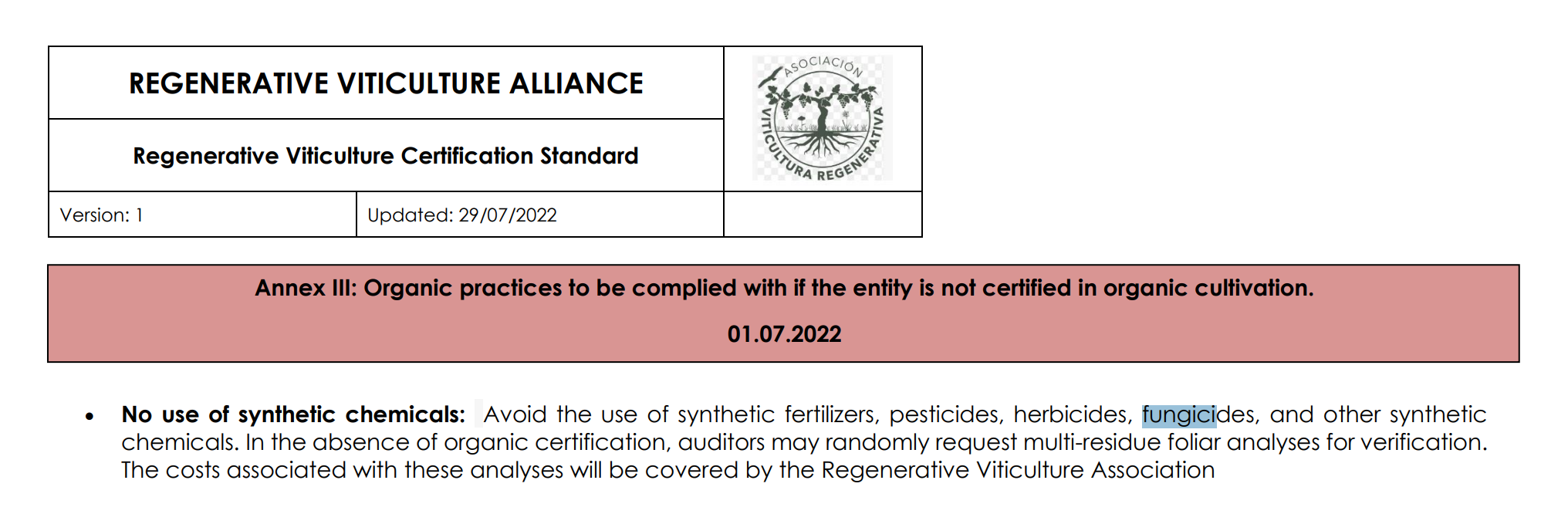
The Regenerative Viticulture Association is a specialist body established in Barcelona in 2021. Its regulations prohibit any use of synthetic products, and although it does not require organic certification, it requires adherence to organic practices:
A Greener World is a global non-profit headquartered in Oregon which offers multiple certification programmes. Certified Regenerative by AGW provides a highly detailed set of standards, but becomes slightly nebulous when it comes to synthetics.
All synthetic products (herbicides, fungicides, insecticides) are listed in their annex of restricted products with the following advisory: “The Restricted Materials listed above may only be used if planned and targeted as part of the approved Regenerative Plan. Use must be phased out over time, as agreed with AGW.”
Am I alone in finding this incredibly vague?
Regenified is a Dallas-based organisation whose certification allows the use of synthetics under certain conditions. For orchards and other perennial plants including vineyards, It stipulates that pesticide usage “must decrease each year”.
There are vague statements such as “Before the use of any pesticide (herbicides, fungicides, or insecticides), a basic pest management plan must be developed.” – so it’s fine to spray chemicals as long as you have a plan!
Keep it simple
I’ve only scratched the surface. The number of routes to something called ‘regenerative’ certification keep increasing. Jason Haas’s fear that “regenerative becomes diluted to the point that it doesn’t mean anything more than ‘sustainable’ does now” seems justified.
Given that organic and biodynamic certification schemes typically define the period when an estate is in conversion – something that can often legally be stated on the label – I suggest that this picture could be simplified.
If growers accept that the core goals of regeneration include phasing out synthetic treatments – something all the standards above assert – it should be possible to work within the bounds of existing organic schemes. Once an estate gains organic certification – however long that takes – they move on to tackle regenerative.
There’s a broader question around the average wine drinker’s ability to make sense of the verbiage festooning back labels. Organic, biodynamic, regenerative, sustainable, natural, sulphite-free, B-corp and vegan appear in endlessly multiplying formations.
The real danger is not the coupling of regenerative and organic. It’s the fragmentation of the certification picture, into thousands of competing logo-shards that hold little to no consumer recognition.